28 November 2011

Zarf

Google search for interesting words beginning with 'Z' revealed this delight.

It is an ornamental holder for a hot coffee cup. Match this with a cigarette holder, and one has a recipe for coolness.

It is from the Arabic word meaning envelope or container.

27 November 2011

Caulking

To seal a gap with a substance;
To make a boat water-tight.

Sometimes I feel as if uni doesn't exactly caulk me, merely highlights places where caulking is needed. Then the caulk is applied, only that application highlights smaller holes. Then, everything explodes and the boat falls apart and the only things left are the substances used to caulk in the first place; and the occasional spattered fragment of what used to be a brain.

25 November 2011

Smörgåsbord

Smörgåsbord (pronounced shmawr-guhs-bawrd) meaning an extensive array or variety, often used in reference to food in which case it means a buffet meal of various hot and cold foods.

Etymology:
1893, from Swed. smörgåsbord "open sandwich table," lit. "butter-goose table," from smörgås, which is said to mean "bread and butter," but is compounded from smör "butter" (related to smear) and gås, lit. "goose" (and from the root of English goose), which is said to have a secondary meaning of "a clump (of butter)." The final element is bord "table" (cf. (n.1)). Figurative sense of "medley, miscellany" is recorded from 1948.

22 November 2011

Globule

A small spherical body.  

Sometimes shortened to glob, this word came to me when a friend texted me and my response to her was glob as it was an anagram of the word she had sent me.

Etymology:
1660s, from Fr. globule, from L. globulus, dim. of globus “globe”

21 November 2011

Brobdingnagian

From Jonathon Swift's Gulliver's Travels. The people of Brobdingnag were giants, hence the adjective is now used to describe anything of colossal size.

I haven't read the book in years; perhaps I should reread it.

15 November 2011

Chrysanthemum

When I was a kid and would read the Babysitters' Club over and over again, this was in one of the books. The word took around 5 goes to get, but I've been able to spell and say it since. I just love the way the word sounds. Chris an' the mum - it's made for some really good cryptic crossword clues as well.

Etymology
Chrysos: gold
anthos: flower

While looking up the etymology, the word anthos reminded me of anthology. On looking this up, it turns out that anthology means 'flower pressings'.

Apocrypha

esoteric; of questionable authenticity

Oft used in religious circles to describe a book or piece of writing that is considered useful but not the word of god.

I just like the way it sounds :-)

Etymology:
From the Greek meaning hidden away

13 November 2011

Asinine

A glorious word meaning extremely/excessively stupid or foolish.

When used in a sentence, "Adam's asinine actions", it sounds so much better than saying, "Adam's extremely stupid actions".

Etymology:
c.1600, "obstinate, stupid," from L. asininus "stupid," lit. "like an ass," from asinus "ass," also "dolt, blockhead" (see ass (1)). The literal sense in English is recorded from 1620s.

Esoteric

Rarely used in normal conversation which is not that strange when you look at the meaning. Esoteric means intended for or understood only by a select few. It can also mean private, secret, confidential.

I have heard it used in the past to describe a person. I would guess that when someone is described as esoteric it means that they are a very private or secretive person.

Etymology:
1650s, from Gk. esoterikos "belonging to an inner circle," from esotero "more within," comparative adv. of eso "within," related to eis "into," en "in" (see en- (2)). In English, originally of Pythagorean doctrines. According to Lucian, the division of teachings into exoteric and esoteric originated with Aristotle.

12 November 2011

Non Sequitur

You know the thing that has always fascinated me about words like this is when they, illogically, only have a two word function. I mean, have you ever heard someone talk about a sequitur? I haven't, I've only heard it used with the non in front.

A non sequitur is a statement that does not follow logically from or isn't clearly related to previous content.

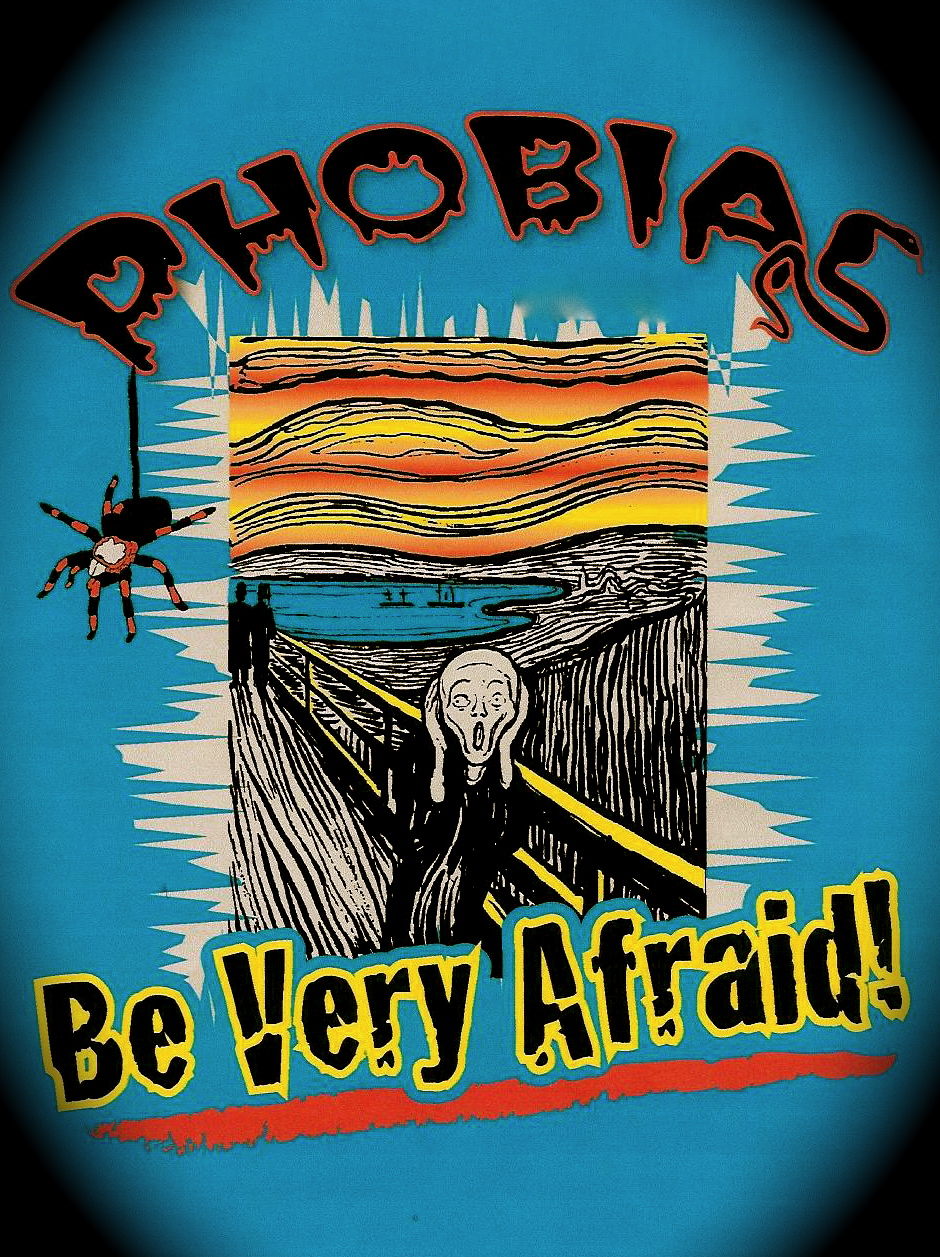
This post was a non sequitur from the previous ones about phobias.

Haphephobia

A very interesting phobia that I guess I always knew about, but never knew the proper term for.

It means a  fear of being touched.  We probably all know someone who doesn't like casual touches but I don't think I've ever met anyone who cannot stand any touch at all and is actively frightened of being touched.


Etymology:
From the greek Haphe - to touch

Phobia

Generally used to mean scared of. Official meaning is an extreme or irrational fear of or aversion to something.


Etymology:
1786, "fear, horror, aversion," Mod.L., abstracted from compounds in -phobia, from Gk. -phobia (in widespread popular use with native words from c.1800), from phobos "fear," originally "flight" (still the only sense in Homer), but it became the common word for "fear" via the notion of "panic, fright" (cf. phobein "put to flight, frighten"), from PIE base *bhegw- "to run" (cf. Lith. begu "to flee," O.C.S. begu "flight," bezati "to flee, run," O.N. bekkr "a stream"). Psychological sense attested by 1895.

9 November 2011

Syndicate

A group of individuals or organizations combined to promote some common interest

Etymology
syndic: One who helps in a court of justice (Greek and Late Latin)
-ate: Latin suffix meaning 'one who'

After having just syndicated this blog onto my own website, it only seems fitting. The Greek prefix 'syn-' means with or together, and I like how harmony is implied in this word.

It also rhymes with indicate, so there is much potential for interestingness.

Sybarite

a person who is self-indulgent in their fondness for sensuous luxury.

Oh 'twould be lovely to have the time to be a sybarite!

8 November 2011

Obsequious

Obedient or attentive to an excessive or servile degree
Also, bootlicking: arselicking etc

When I hear the word obsequious it conjures up an image of a very large/portly in the extreme, greasy/oil covered man who is trying to get something from someone by fawning all over them.  This man (to me) looks remarkably like the Baron from Dune! 


Etymology:
late 15c., "prompt to serve," from the Lain - obsequiosus "compliant, obedient," from obsequium "compliance, dutiful service," from obsequi "to accommodate oneself to the will of another," from ob "after"+ sequi "follow" (see sequel). Pejorative sense of "fawning, sycophantic" had emerged by 1590s.

7 November 2011

Exasperate

to cause irritation or annoyance

Oh my! Some people are so exasperating I don't know how they cope.  From adults to children everyone has the potential to be exasperating.  Do people have the kind of personality where they just find everyone exasperating even if they are not so?

4 November 2011

Undulate

The simple meaning is wavy. More complicated definitions include a wavy surface or a sound that goes up and down in tone.

Undulate, to me, sounds very smoothed and curved so I would not describe an N as an undulating letter. I would however describe m as more like an undulating form.

Veneniferous

bearing or transmitting poison and especially a natural venom.

Therefore, one could describe some snakes as being veneniferous. I would also go as far to describe some of the people I know as veneniferousthough their poison is generally verbal rather than chemical :-)

Tenacious

Tenacious is a glorious word meaning holding fast or firmly. It can be used in many ways such as a tenacious memory or referring to an object such as tenacious dirt that sticks and is difficult to remove.

Etymology:
c.1600, from L. tenaci-, from tenax "holding fast"

Paradox

One of my favourite words in the English language, purely because I adore paradoxes.

"This statement is false."

"The following statement is false.
The preceding statement is true."

Over-quoted perhaps but at this time of night, that's all I can think of!

Etymology
From the Ancient Greek paradoxos, meaning unexpected or strange, which in turn comes from:
para-: side-by-side
dox-: opinion / tenet